- It's odd how 100-million dollar businesses -- namely the storied baseball teams -- are run turning a blind eye to correctly valuing their most important assets. In this milieu, a small-pocketed upstart -- in this case a low-budget baseball team --earns disproportionate success by arbitraging these discrepancies. The parallels with statistical arbitrage in hedge funds are striking.
- Much of the analysis that underlies the Oakland As' predictive models may be traced to the work of pioneering baseball newsletter writer Billy James. James discovered novel statistics to use to value baseball players, instead of the measures that had been inherited from a time when the game was fundamentally different -- for example when fielders were folks on leave from the army who played without mitts. He was faced with poor, inadequate data that was being sold for rip-off prices by established data gathering firms. Pricing aside, these firms were not interested in changing their ways and making a truly useful product offering that was being sought by this new breed of enthusiasts. As a result there arose a small, underfunded volunteer base to gather such statistics. This, to me, is the baseball equivalent of the present-day open-source phenomenon.
Thursday, October 01, 2009
Moneyball
I just finished reading Michael Lewis' book Moneyball. I enjoyed this book even though I know next to nothing about baseball. This is the amazing story of the Oakland Athletics written circa 2002. At that time the Oakland As raised eyebrows because they were one of the lowest budget teams in Major League Baseball, yet, had demonstrated remarkable success. Their accomplishment was dismissed by many as being the product of luck. The book goes on to describe how the ascendancy of the As was the result of a superior strategy at their front office which built predictive models of team wins based on player statistics which were being overlooked by other teams. This allowed them to zero in on the deeply undervalued players, and trade their own overvalued players to build cash reserves and draft pick opportunities. The Oakland As were, in essence, a baseball hedge fund. Two comparisons to things, I have had some connection with in my work, struck me as interesting:


Saturday, September 05, 2009
The Undercover Economist

Ponder the following questions:
- You are the owner of a coffee chain, and you determine that 80% of your customer base will support a price of $2.20 for a latte, while 20% is not price sensitive. What should your pricing strategy be?
- Subsidies and social safety nets, often, promote fairness in an economy at the expense of efficiency. How can you subsidize heating bills for the poor elderly in Minnesota without distorting free market forces?
- You are trudging home from work, when a 6'8", 250-lb man called Tiny stops you, and another passerby. He seizes your wallets, but asks you both to secretly bid for the cash in the two wallets put together. What should you bid assuming you know the contents of your wallet?
Tim Harford, the author of The Undercover Economist, writes a clever, witty column in the Saturday Financial Times. He, typically, picks a silly-sounding quandary posed by a reader, and proceeds to offer an insightful analysis and solution, drawing on ideas in economics and game theory. This book follows a similar pattern though the topics he examines are considerably weightier: they span issues as different as product pricing, trade theory, wireless spectrum auctions, and macroeconomics. He emphasizes familiar themes -- incentive structures determine an economy's path; competitive advantage drives specialization; social capital is essential for economic growth of nations; trade enriches everyone. But, he employs these ideas to debunk many common woolly-headed arguments -- that multinationals impoverish everyone by way of building sweatshops, or that globalization has led to massive environmental degradation.
I found the questions in the book very interesting even if, on occasion, I found some of the discussions less than complete. For instance, the chapter on spectrum auctions left me intrigued but none the wiser. The final chapter on the drivers for China's explosive growth is probably the best, and just by itself, well-worth the price of the book.
Wednesday, August 26, 2009
Phantoms in the Brain
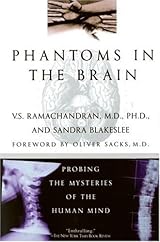
This is one of the best popular science books I've read in the last decade. A potential Nobel winner, Ramachandran -- a renowned neuroscientist at the University of California San Diego -- describes his intriguing analyses, and deductions of the structure of the human brain, with great wit and eloquence. The neurological challenges that he discusses span a wide gamut: from phantom limbs (where people continue to 'feel' amputated limbs) to Capgras' syndrome (where a person sees his mother and is reminded of his mother rather than recognizing her as such); from blindsight (where a person cannot 'see' an object, and yet exhibits motor responses to its presence), to heightened religious feelings accompanying seizures. Ramachandran surmises aspects of the brain's architecture from the symptomology of these disorders, and designs and conducts simple clinical experiments seeking confirmation for his hypotheses. There is something stirring about attacking fundamental questions through low-tech experiments -- something reminiscent of the experiments of Galileo, and the thought experiments of Einstein.
Finally, I admire the open-mindedness, intellectual honesty, and scientific spirit he brings to problematic topics such as the neural basis of consciousness, and religious experience. It takes great sophistication and wisdom -- something that is demonstrated in ample measure in this book -- to address these areas without sounding specious, oversimplifying, or vague.
Saturday, August 15, 2009
Malcom Gladwell's book Outliers

I enjoyed Malcom Gladwell’s Blink when I read it about a year ago, so I approached his recent book Outliers with much expectation. I wasn’t disappointed. Like Blink this book has a concisely statable thesis: there are factors that influence success which have greater impact than talent, work ethic or character. Possible factors are personality traits, latent biases in the system, or the propitiousness of time and place.
In some instances there is a lesson to be drawn. Gladwell describes the contrasting life trajectories of two geniuses, Chris Langan and Robert Oppenheimer. Chris Langan is the highest IQ American today. Despite effort and ambition, success seems to have eluded him. On the other hand, Oppenheimer, the physicist who headed up the Manhattan Project, went on to fame and glory (until things caught up with him in the McCarthy era). This was inspite of unseemly episodes – as when he was charged with plotting to poison his doctoral adviser! –, and controversies relating to his communist leanings. Gladwell argues that what swung it for Oppy was his extraordinary charm, something that separates him from Langan. Raw intelligence doesn’t cut it beyond a point.
However, more often than not there is no apparent lesson: success is influenced by factors that a person has no control over. We all know people for whom the key driver of success was being in the right place at the right time. One of Gladwell’s most interesting examples is a list of the richest people in history, with wealth normalized to the present time. Nearly 20% of this list comprises people born in the U.S. in the 1830s. The putative reason is that these people were at the right age, and the at right place, to benefit from the post-Civil War reconstruction, specifically the railroad boom. Of course they were immensely talented but that couldn't have been the sole, or even predominant, explanation for their success: as Gladwell notes, the distribution of talent couldn’t have been so generous to one specific decade in history.
It is when Gladwell strays beyond the confines of the thesis stated above that the unity of the material is compromised (I remember having a similar sense about Blink as well). In later parts of the book he discusses such topics as why Korean Air had a concentration of accidents during a certain period, or why Asian children who trace their roots to Southern China have done very well academically. The point he seeks to illustrate is the impact of cultural traits on work and success. His final chapter on the chance events that shaped the history of his own family also strains the coherence of the material.
But, those nits aside, most of the case studies in the book are interesting, memorable, and fun. Two thumbs up.
Monday, August 10, 2009
Stress Relief
I have, recently, been looking at some stress relief tools, life being what it is in these difficult times.
I recommend the meditation podcasts at the site http://www.themeditationpodcast.com. I found episodes 1, 2, and 3 particularly helpful. These are guided meditations lasting about 20 minutes. I found these extremely relaxing especially in the evenings or when going to bed. It helps to sit in a comfortable chair, or lie down on a bed, and put on a pair of headphones. I have always had difficulty meditating, and this podcast is helpful.
A second website I have enjoyed is http://www.freehypnosistreatment.com/. The audio/video recordings, here, are also guided meditations of sorts. Don't let popular negative opinion on hypnosis throw you off. There is nothing damaging about hypnosis: a hypnotist cannot seize control of your mind to make you do things you don't want. It's very relaxing to listen to a hypnosis script. The guy who speaks on the audio here has a lilting Irish accent, and a soothing voice. I found his video on anxiety, and his audio on positive thinking, very good.
Finally, let me mention two interesting, related technologies. One is the use of biofeedback hardware to give you an introduction to meditation through video gaming. The hardware/software Wild Divine video game is in this space -- their hardware has two sensors: one for measuring the heart rate and the other for measuring skin conductance (galvanic resistance). It is quite pricey ($200+) so I haven't tried it. The other is the so-called binaural beats: a person's EEG has waves in different spectral regions, and the so-called alpha waves -- which meditators exhibit -- are in the 10 Hz range. By sending two different harmonics separated by 10Hz to the two ears, a 10Hz beat is supposedly synthesized in the brain. You will find binaural beats in many meditation music CDs (as well as the meditation podcast mentioned above). For free binaural beats without any music on top look at http://i-dose.us. It is recommended that you use high-quality stereo headphones (with no crossfeeds). I should say the binaural beats stuff didn't do much for me, but your mileage may vary.
The stuff in the last paragraph may sound weird to some, so be it. I am not expert enough to know if these are gimmicks or not, but from what I have heard, these are useful innovations for kids, beginners, and those who have difficulty getting into the meditation groove.
I recommend the meditation podcasts at the site http://www.themeditationpodcast.com. I found episodes 1, 2, and 3 particularly helpful. These are guided meditations lasting about 20 minutes. I found these extremely relaxing especially in the evenings or when going to bed. It helps to sit in a comfortable chair, or lie down on a bed, and put on a pair of headphones. I have always had difficulty meditating, and this podcast is helpful.
A second website I have enjoyed is http://www.freehypnosistreatment.com/. The audio/video recordings, here, are also guided meditations of sorts. Don't let popular negative opinion on hypnosis throw you off. There is nothing damaging about hypnosis: a hypnotist cannot seize control of your mind to make you do things you don't want. It's very relaxing to listen to a hypnosis script. The guy who speaks on the audio here has a lilting Irish accent, and a soothing voice. I found his video on anxiety, and his audio on positive thinking, very good.
Finally, let me mention two interesting, related technologies. One is the use of biofeedback hardware to give you an introduction to meditation through video gaming. The hardware/software Wild Divine video game is in this space -- their hardware has two sensors: one for measuring the heart rate and the other for measuring skin conductance (galvanic resistance). It is quite pricey ($200+) so I haven't tried it. The other is the so-called binaural beats: a person's EEG has waves in different spectral regions, and the so-called alpha waves -- which meditators exhibit -- are in the 10 Hz range. By sending two different harmonics separated by 10Hz to the two ears, a 10Hz beat is supposedly synthesized in the brain. You will find binaural beats in many meditation music CDs (as well as the meditation podcast mentioned above). For free binaural beats without any music on top look at http://i-dose.us. It is recommended that you use high-quality stereo headphones (with no crossfeeds). I should say the binaural beats stuff didn't do much for me, but your mileage may vary.
The stuff in the last paragraph may sound weird to some, so be it. I am not expert enough to know if these are gimmicks or not, but from what I have heard, these are useful innovations for kids, beginners, and those who have difficulty getting into the meditation groove.
Subscribe to:
Posts (Atom)